
 English
 Español
 عربى

 Home / Blog / Industry News / Types of Wood Grain: Patterns, Selection Criteria, and Decorative Film Performance

Industry News
Types of Wood Grain: Patterns, Selection Criteria, and Decorative Film Performance
2026-11-16
A cabinet door sample can carry the same “oak” label as three very different surfaces: one with cathedral arches, one with straight lines, and one with a burl cluster. The difference is not cosmetic. It changes how the door reads under kitchen lighting, how much film a wrapper consumes per cycle, and how closely the edge band matches the face.
Short answer: types of wood grain are best judged on three levels: the species pattern, the cut orientation, and the surface texture. For decorative film buyers, the practical match is the pattern that survives the target gloss, emboss depth, and processing method — not the one with the most detailed catalog photo.
Content
What Creates the Grain You See
Wood grain begins as growth rings. A plain sawn board cuts across those rings and produces wide arches. A quarter sawn board cuts closer to the radius and reveals straighter lines with ray flecks. Rift sawn material is cut at a steeper angle and gives the quietest, most linear face. Species adds another layer: open-grain woods such as oak and ash carry visible pores, while closed-grain woods such as maple and cherry read smoother.
Decorative films reproduce those cues with print and emboss. Print controls color and line direction. Emboss controls how light scatters across the surface. A deep synchronous emboss can make a straight grain feel like brushed oak; a shallow matte emboss can make the same print look like painted veneer. That is why two films with the same pattern name can perform differently on a vacuum press, a flat laminator, or a wrapping line.
Visual grain
Print register, color depth, and contrast. A high-gloss film shows every misalignment; a matte film hides more.
Tactile grain
Emboss depth and cell structure. Too much texture can trap dust; too little can look flat on a large door.
Process grain
Stretch, heat, and adhesive flow. A pattern that looks right on a flat panel may distort on a wrapped profile.
Six Wood Grain Patterns That Drive Specification
Most furniture and cabinetry specifications land on a small group of recognizable patterns. The table below compares the visual signature, common use, and buying risk for each.
Table note: the same pattern name can cover different print scales, so approve a physical sample at final gloss and emboss.
The Same Oak Under Different Light
Grain is not only a print pattern. Gloss level, emboss depth, and lighting temperature change perceived contrast. A small gloss shift can make a cathedral pattern look louder in a showroom and calmer in a finished kitchen. For buyers, that means the approval process should include the actual lighting condition, not only a flat catalog page.
Perceived grain contrast index (sample basis)
Plain sawn
Quarter sawn
Rift sawn
Burl
Straight
Higher index means stronger visual contrast at 4000K and 60-degree gloss. The values are a planning aid, not a specification; approve a physical sample before release.
For high-clarity wood-grain print, PET decorative film is often specified when the face needs tighter register and lower haze. It accepts fine line detail well, but it also shows scratches and fingerprints more readily than a matte PVC surface.
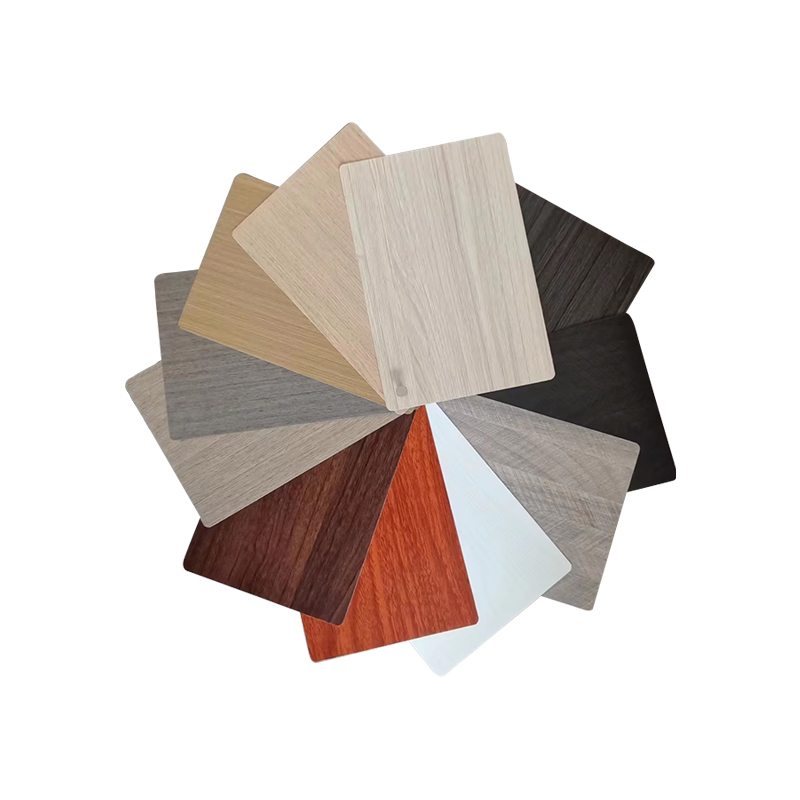 Wood Grain PET Decorative FilmHigh-clarity PET wood-grain film with scratch-resistant coating for premium furniture, cladding, and automotive interiors; worth reviewing where fine print detail and surface finish matter.View Product →
Where Wood-Grain Surfaces Go
Wood-grain decorative films are not evenly distributed across applications. Furniture and cabinetry dominate because the film must balance appearance, processing speed, and edge match. Flooring and wall panels follow different rules: they need more wear resistance, moisture tolerance, or self-adhesive installation.
Furniture faces: 46%
Cabinetry: 27%
Flooring: 15%
Wall and panel: 8%
Exterior: 4%
For furniture and cabinetry faces, PVC decorative film is the volume workhorse. It offers a wide pattern range, good conformability on membrane presses, and predictable cost. The trade-off is that very high gloss can reveal surface defects, and dark wood grains show dust more quickly in a finished kitchen.
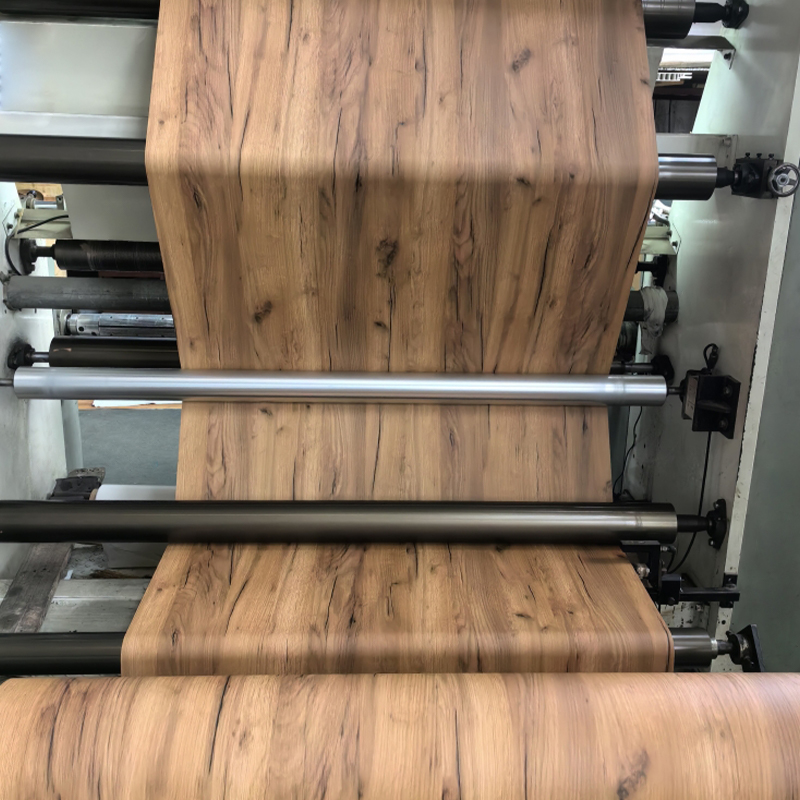 Wood Grain PVC Decorative FilmPVC wood-grain film for furniture, cabinets, wall panels, and doors; a practical volume material for membrane pressing, laminating, and profile wrapping.View Product →
Selection Guide: From Sample to Sign-Off
A wood-grain film should be selected the way a production material is selected: by pattern, process, and total yield. The sequence below keeps the decision practical.
1
Define the visual target. Name the species, cut, gloss, and emboss. “Oak” alone is not a specification.
2
Match substrate and process. PVC suits vacuum pressing and wrapping; PP suits recyclable or flooring programs; PET suits clarity and scratch resistance.
3
Run a three-sheet trial. Measure cut yield, scrap rate, color shift after pressing, and edge match before approving a full roll.
4
Check edge banding. ABS and PVC edge banding should match the face in color, gloss, and grain direction. A close match reduces rework at assembly.
5
Validate supply and compliance. Request UV, scratch, moisture, and indoor air reports. Confirm roll width, repeat length, and lead time against the production plan.
For flooring or projects with recyclability targets, PP decorative film can be a better fit than PVC. It is lighter, resists moisture well, and can be formulated for UV exposure, but its print sharpness and gloss range may differ from PVC.
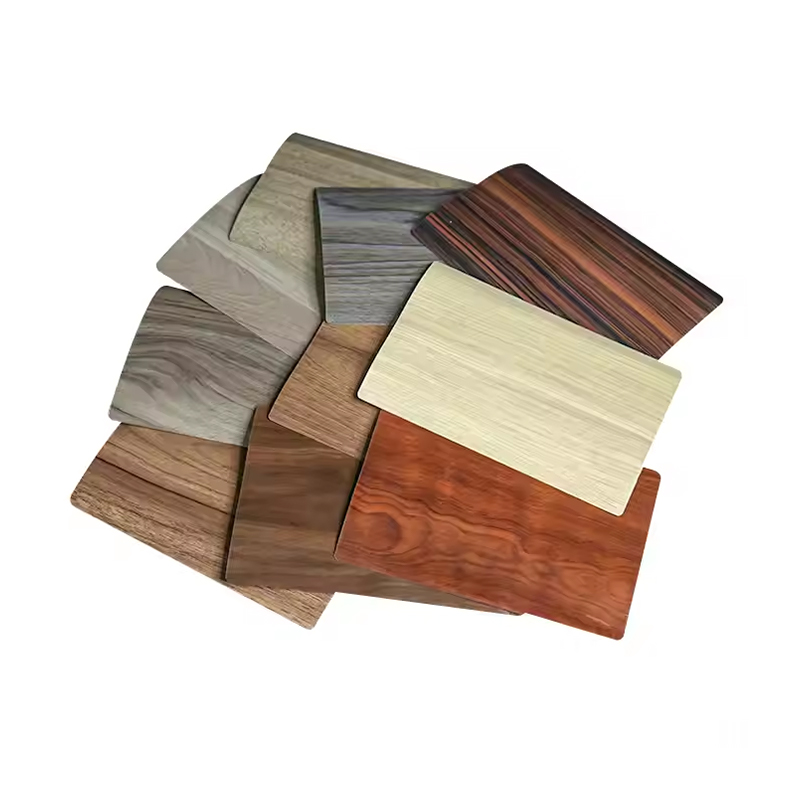 Wood Grain PP Decorative FilmEco-friendly PP wood-grain film for moisture-resistant, recyclable applications such as outdoor furniture and packaging; suitable for laminating and profile wrapping.View Product →
Maintenance and Compliance Checks
Wood-grain films keep their appearance longer when cleaning is matched to the surface. A soft cloth with mild detergent is usually enough. Abrasive pads, solvent-heavy cleaners, and standing water can dull the emboss or lift an edge. On high-gloss PET, fingerprint removal should be done with a dry microfiber cloth first, not a wet wipe.
- Confirm scratch and stain resistance against the actual cleaning chemicals used by the customer.
- For exterior or near-window use, request UV stability data and color-shift limits.
- Store rolls in a dry, shaded area and allow them to reach room temperature before lamination.
Ask suppliers about manufacturing controls and surface texture consistency, not only pattern catalogs. A stable emboss and print register matter more than a large color card when production runs month after month.
The most reliable buying decision comes from matching the grain pattern to the process that will form it. A cathedral oak film may be perfect for a flat cabinet door and risky for a deeply wrapped profile. A straight rift pattern may look plain in a sample book and premium on a full-height wardrobe. Start with the visual target, confirm the substrate and press, then approve a physical sample at final gloss and emboss.
Final takeaway: types of wood grain are a specification package, not a single image. Species pattern, cut direction, print scale, emboss depth, gloss, and edge match must work together. When they do, the film reads as wood; when they do not, the surface reads as a printed roll.

Recommended Articles
-
1.1 What is PP Decorative Film? PP decorative film is a type of surface material made primarily from polypropylene, a versatile and widely used thermoplastic po...
View More -
Is your furniture looking tired, outdated, or damaged? Imagine transforming it effortlessly into something stunning, durable, and uniquely yours. Enter PVC deco...
View More -
1.Introduction Edge banding is a crucial finishing process used in woodworking and furniture manufacturing to cover and seal the exposed sides of materials such...
View More
Xuanyi

Feel free to contact us
Xuanyi, dedicated to the application and research and development of new materials. Furniture Decorative Film Maufacturers and Factory.
Product Fast Links
Contact Information
-
 Room G, 4th Floor, Bailingshi Building, Haizhou Street, Haining City, Jiaxing City, Zhejiang Province, 314400, China
-
 [email protected]
-
 +86-15059290610
-
 +86-15059290610
Copyright © 2024Jiaxing Xuanyi International Trade Co.,Ltd All Rights Reserved. PVC/PP/PET Lamination Film for MDF WPC Plywood

